 Re-process
is a project of young Italian authors working in the field of art,
fashion, design and architecture, on the topic of inventive solutions
for recycling existing objects and "poor" materials. Re-process
is a project of young Italian authors working in the field of art,
fashion, design and architecture, on the topic of inventive solutions
for recycling existing objects and "poor" materials.
Project of exhibition Re/Process has been conceptualized expecially
for this edition of Belgrade Summer Festival (Beogradski Letnji
Festival – BELEF) meaning a series of events that would
present some of the most interesting young authors, who are currently
active on the Italian stage in the fields of art, architecture,
design and fashion.
This Project focuses on those authors who base their creative
approach on the principle of recycling and finding innovative
and unexpected solutions for utilization of already existing
facilities and materials. They act from the positions of ecologic
consciousness in the time of increasingly accelerated industrial
hyper-production, and by their work and attitute they form
new ethical positions that need to be confirmed in the field
of art, as well as in the fields of other productive disciplines.
Besides the work principle meaning processing practices and
recycling, characteristic for all three suggested authors: Deborah
Ligorio, Pietra Pistoletto and Antonia Skarponia, one another
interesting note is appearing, linking those artists, otherwise
of very different formal approach, and that is interest for “personalized” design
and openness to different forms of interaction with audience.
Pietra and Armona Pistoletto are working in the field of fashion
and design. Their project covers informal fashion shows, bazaars
of garments and non-utilitary goods, with active participation
of the public throughout the whole exhibition process.
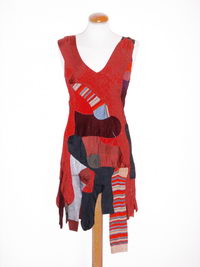
Fashion creations of Pietra Pistoletto are using experiences
of Arte Povero ("Poor art") and are based on utilization
of the existing clothes as constructive elements for new creations.
Young Italian Architect and Designer, Antonio Scarponi, forms
his creative approach on the premises of tendencies within the
Italian art and architecture from the end of’ ‘60s,
creating innovative works: engaged computer animations, comments
on the political map of the world and recycled utilizable goods
resulting from ecologically inspired attitudes.
|