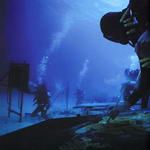
The "Memorial Project Nha Trang,
Vietnam: Towards the Complex - For the Courageous, Curious
and the Cowards" is the first film by Jun Nguyen - Hatsubibe,
a young artist of Vietnamese origin, born in Japan and raised
in the U.S. Since different cultural influences have been blended
in the origin and development of this artist, his work is set
in the domain of multicultural discourse, that is in the domain
of the very current debate that is redefining the questions
of "in between" identity, primarily from peripheral
Asian regions. All films that he has made so far are characterized
in their titles as memorial projects - as kind of commemorative
moments, which refresh the remembrance of tragic events of
recent history and the suffering of the Vietnamese people,
at the same time accentuating the consequences of the process
of global transformation and the loss of specific elements
of national culture.
In this context, this film from 2001 is dedicated to the
emigrants, also known as "boat people", people
who, after the end of the war and on their return to Vietnam,
degraded and stripped of economic and social status, become
rickshaw drivers, forced to exist at the very margin of society.
The fable of the film "Memorial Project Nha Trang, Vietnam" takes
place at the bottom of the ocean and describes an imaginary
race of rickshaw drivers, who are putting superhuman effort
into the fight for survival. On the other hand, underwater
pictures created by Hatsubibe have an appearance of sequences
of an uncertain memory, or of a faded, bluish vision in which
borders between memory and reality, between emotion and historic
fact, are lost. This is the topic of the second film "Ho!Ho!Ho!
Merry Christmas - Battle of Easelpoint - Memorial Project
Okinawa", recorded in waters around Okinawa, in the
former U.S. military base, which refers to the Vietnam war
and the Hollywood film mythology constructed around their
biggest war defeat. |